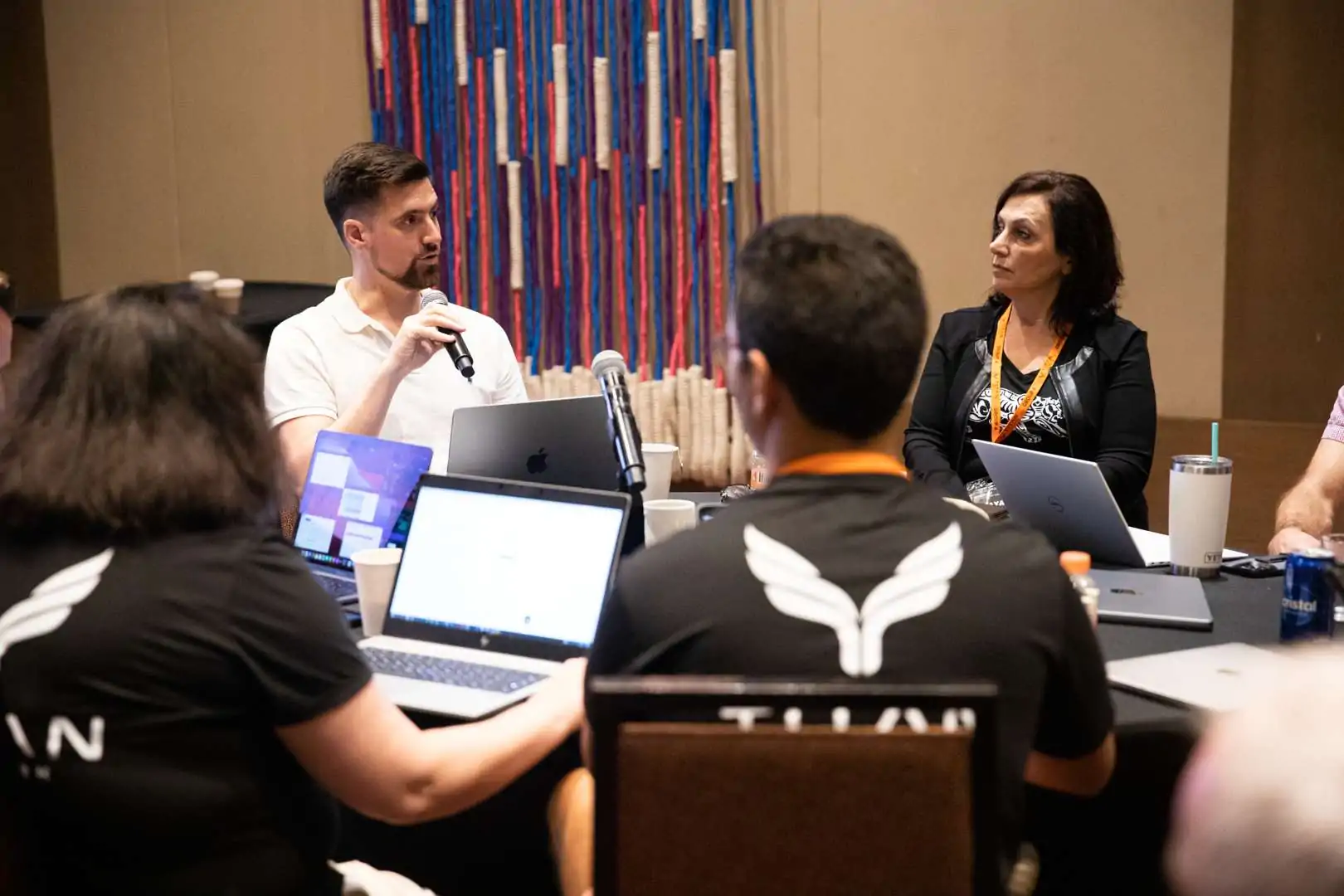
Best communities for scaling to 30M revenue.
Why $1M+ Amazon Sellers Hit Growth Walls Without Strategic Peer Networks
The High-Revenue Seller’s Dilemma
You’ve built a business generating $1M to $10M annually. You’ve weathered algorithm shifts, supplier disruptions, and margin compression. But here’s what most don’t tell you: best communities for scaling to 30M revenue become mission-critical at this stage because your challenges have outgrown generic advice.
Your local business group can’t solve supply chain optimization at scale. Your accountant doesn’t understand DSP attribution models. You need peers who’ve already crossed the $30M threshold and can share the specific systems that got them there.
What Elite-Level Community Actually Means
We’re not talking about networking events or Facebook groups. Elite community means structured access to battle-tested frameworks, real-time market intelligence, and accountability systems that show up on your P&L statement.
The difference? Members share actual conversion rates, not just motivational quotes.
Which Community Models Actually Drive $30M Revenue Growth
Here’s the reality: not every community produces measurable returns. You need to pick the model that solves your biggest constraint.
Community Type Comparison
| Community Type | Primary Benefit | Revenue Impact | Best For |
|---|---|---|---|
| Mastermind Groups | Strategic accountability | High | Decision-making at scale |
| Industry Forums | Niche intelligence | Medium | Category-specific tactics |
| Customer Communities | Owned audience | High | Reducing PPC dependence |
| Creator Networks | External reach | Medium-High | Brand awareness growth |
The ROI Test
Ask yourself: does this community help me make faster decisions, avoid costly mistakes, or spot opportunities before competitors? If not, you’re paying for social time, not business growth.
Top communities share three things: members reveal actual numbers, discussions focus on profit improvement, and you walk away with specific actions to implement this week.
Building Your $30M Growth System Through Strategic Community
The Data Ownership Foundation
Every community strategy starts with owning your customer data. If your audience lives on someone else’s platform, you’re building on rented land. Capture emails at every touchpoint and build first-party data assets you fully control.
Your Community Profit Checklist
- Document SOPs for every repeatable operation (and share them for feedback)
- Set up peer accountability with structured quarterly reviews
- Track community ROI against specific revenue metrics
- Assign team members to execute community-sourced insights
- Create feedback loops that capture what’s actually working
Peer Networks as Your Virtual C-Suite
Elite communities function like having seasoned advisors without the equity dilution. These relationships expose blind spots in your positioning, pricing, and operations. The right group can save you months of testing and thousands in mistakes.
One conversation can prevent a $50K inventory error. That’s community ROI you can measure.
Case Study: How Strategic Community Broke Through $8M Revenue Plateau
Real Numbers, Real Results
The Challenge: A Titan Network member selling home goods stalled at $8M annual revenue. Traditional scaling tactics weren’t moving the needle.
The Breakthrough: Community intelligence revealed bundle opportunities and supplier renegotiation strategies the internal team had missed. Specific: other members shared their successful bundle pricing models and introduced connections with better suppliers.
The Results: Two quarters later, margin expansion contributed to a clear path toward $12M+ revenue milestones.
Your Implementation Window
Time compounds community benefits. The sellers who build these networks earlier get better returns because relationships deepen and trust builds.
Pick one community aligned with your biggest constraint. Commit to showing up consistently. Track results against specific profit metrics, not just feelings.
Elite operators treat community as a profit center, not a networking expense.
Your Strategic Community Roadmap to $30M Revenue
What Actually Separates $30M Sellers
The pattern is clear: sellers who measure community participation against profit metrics consistently outperform isolated operators. Best communities for scaling to 30M revenue deliver three measurable advantages: faster decisions, avoided capital-draining mistakes, and market intelligence that surfaces opportunities months before competitors notice.
Bottom Line: Community investment pays when you track avoided mistakes, shortened decision timelines, and margin improvements from peer input. Most members report strong ROI on community spend when they actually measure it.
Three Trends Reshaping Elite Seller Communities
AI-augmented intelligence: Machine learning now aggregates patterns from peer inputs that took years to spot manually. Communities using these tools give members an edge in inventory planning and demand forecasting.
Regulatory compliance networks: As marketplace rules tighten globally, shared compliance intelligence becomes part of your operating system. The cost of regulatory mistakes rises quickly at scale.
Cross-marketplace coordination: Top communities now support synchronized execution across Amazon, Walmart, Shopify, and emerging channels. Single-platform strategies lose effectiveness as acquisition costs rise.
Your Action Plan
Strategic Advantages
- Faster decisions through peer validation
- Preserved capital through avoided operational missteps
- Earlier signal on market shifts
- Access to frameworks tested at enterprise scale
Common Pitfalls
- Passive participation without measurable commitments
- Joining communities misaligned with your growth stage
- Failing to track ROI against specific profit metrics
- Overinvesting in breadth instead of depth
Best communities for scaling to 30M revenue require deliberate selection and active engagement. Titan Network provides a structured environment where seven- and eight-figure sellers translate community participation into measurable progress.
The framework exists. The peers are ready. Execute now.
Frequently Asked Questions
How do I find the best communities for scaling my Amazon business to $30M?
Look for structured environments where members share battle-tested frameworks and real-time market intelligence. Prioritize groups that focus on profit drivers and direct impact on your EBITDA, not just morale. The right community provides strategic advantages that compound growth over time.
What future trends will impact communities for high-level Amazon sellers?
Expect to see AI-augmented community intelligence, helping identify patterns for inventory and pricing. Regulatory compliance networks will become essential for navigating tightening marketplace rules. Cross-marketplace synchronization will also grow, supporting coordinated execution across multiple sales channels.
What common mistakes should Amazon sellers avoid with strategic communities?
Don’t participate passively without clear commitments or join groups misaligned with your growth stage. A big pitfall is failing to track the return on investment against specific profit metrics. Overinvesting in many communities instead of deeply engaging with one or two is also a common error.
Why is generic business advice insufficient for Amazon sellers aiming for $30M revenue?
At the $1M-$10M stage, generic advice falls flat because your challenges are unique. You need peers who have already crossed the $30M threshold and understand the strategic isolation of high-level scaling. Their experience provides specific solutions for complex problems.
How do revenue-focused communities help improve my Amazon business's profit?
Revenue communities offer strategic advantages that directly improve your EBITDA. Members share actual profit numbers, conversion data, and supply chain solutions. This peer input leads to faster decisions, helps avoid expensive missteps, and surfaces market opportunities sooner.
What components are essential for a community designed for $30M+ Amazon profitability?
An effective community builds on owned assets like first-party customer data, not rented platforms. It includes systems and accountability, with documented SOPs and structured peer reviews. Expertise sharing acts as a profit driver, exposing blind spots in pricing and operations.
About the Author
Dan Ashburn is the Co-Founder at Titan Network. The world’s leading community for Amazon sellers scaling to 7 and 8 figures. A former top 1% Amazon FBA seller turned growth strategist, Dan has spent the last decade engineering data-driven campaigns that have generated hundreds of millions in marketplace sales and DTC revenue for Titan’s partners.
At Titan Network, Dan, alongside his cofounder Athena Severi and their team of top talent, architects full-funnel growth frameworks that help margin-squeezed, time-poor brands unlock quick wins, shore up profits, and expand beyond Amazon. Their playbooks fuse advanced PPC automation, creative conversion-rate optimization, and airtight supply-chain SOPs. Giving sellers the step-by-step systems, expert mentorship, and peer accountability they need to dominate crowded niches while safeguarding EBITDA.
A sought-after speaker at Prosper Show, SellerCon, and White Label Expo, Dan demystifies algorithm shifts and shares ROI-focused tactics. From DSP retargeting hacks to DTC attribution modeling. Empowering operators to make confident, cash-generating decisions. Titan Network has positioned itself as the world’s premier Amazon Seller Mastermind, providing high-quality tactical strategies and pinpointing growth levers that move the profit needle this quarter.